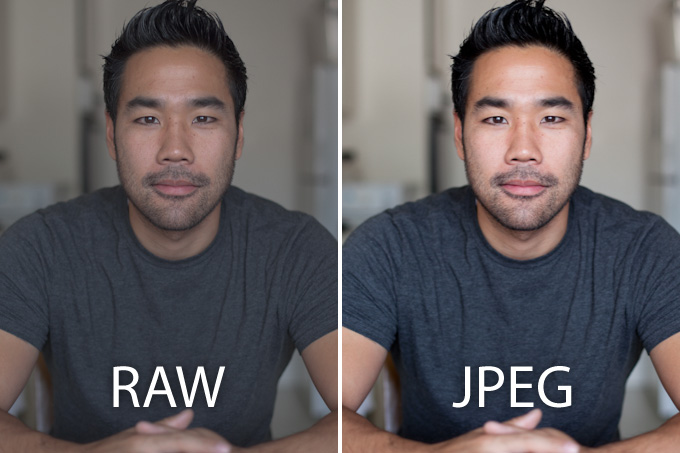
- RAW files preserve image quality and lose no data irrespective of the number of times they are opened and saved.
VS.
- A JPEG image may look fine when it is initially opened, but if it is opened and saved often, it starts to show degradation in quality.
Control of data
- In the JPEG format, an in-camera computer is programmed to convert the raw data captured by the sensor into an image based on the settings (exposure, contrast, sharpening, saturation, white balance, etc.) existing when the picture is made.
VS.
- RAW file conversion, on the other hand, allows the photographer to process all of the original data on a desktop or laptop computer which has considerably more speed and power than the in-camera version.
 |
| www.slrlounge.com |
White Balance
- The color temperature of the light, and often the mood of an image, is controlled by white balance. If a photographer incorrectly sets the white balance on a camera prior to taking a picture in JPEG format, for example, the die is cast. The only hope lies in an attempt to adjust color, hue, and/or saturation in Photoshop to correct the error, and there is no guarantee of success.
VS.
- However, during the process of converting a RAW file into an image, the photographer may reset the white balance to any specific value, just like resetting the white balance before the exposure, without any loss or damage to the underlying data.
Bit Depth
- JPEGs are 8 bit files, and most RAW files are 12 or 14 bit. An 8 bit file can measure 256 tonal values in each of the three color channels, or a total of 16.7 million possible colors per pixel. A 12 bit RAW file, however, can measure 4,096 tonal values per channel, or a total of 68.7 billion possible colors per pixel.
- A JPEG file, therefore, records considerably fewer tonal values than a RAW file. And the tonal values that it does not record are lost forever. As a result, the tonal gradations in a JPEG file are sometimes not smooth.
Exposing to the right
- Once the highlights are truly clipped, they cannot be recovered. To avoid this dilemma, it appears logical to underexpose a scene, and later recapture the brightness in processing.
- However, as you brighten parts of a scene in shadow, you often introduce "noise" into the image. Some compare noise in digital images to the grain seen in film. Both increase as light decreases.
 |
| cameraguyzack.blogspot.com |
End notes: http://www.rondayphotography.com/

No comments:
Post a Comment